


Table of Contents
- Start With the Three Items Every Applicant Must File
- N-400 Supporting Documents That Depend on Your Situation
- If You Are Married, Divorced, or Widowed
- If You Have Traveled Outside the United States
- If You File Taxes
- If You Have Any Arrest, Citation, or Detention
- If You Are a Man Who Lived Here Between Ages 18 and 26
- If Your Name Changed
- Tax Returns, Transcripts, and Continuous Residence Proof
- Court Records, Criminal History, and Selective Service
- N-400 Travel History Documents: Trips Outside the United States
- Additional Evidence for N-400 When Records Are Missing
- N-400 Interview Documents to Bring in Person
- How to Prepare Copies, Translations, and Certified Records
- Frequently Asked Questions
Last Updated: October 19, 2026
Start With the Three Items Every Applicant Must File
Every applicant [filing Form N-400](/tag/file-form-n-400) must send three items on the n-400 document checklist: a photocopy of both sides of the Permanent Resident Card, a passport-style photo, and the filing fee.
Getting this wrong costs months. A missing Green Card copy or an unsigned form triggers a Request for Evidence, and the clock stops while you scramble.
The USCIS Form N-400 page is the controlling source for what counts as required initial evidence. USCIS also publishes a free downloadable checklist, USCIS Document Checklist M-477, that every applicant should print before assembling a packet.
Permanent Resident Card and Identity Documents
The Permanent Resident Card is your proof of lawful permanent resident status, and USCIS wants a clear photocopy of both the front and back.
Alongside the card, include a passport-style photograph taken within the last 30 days. If your name changed through marriage or court order, attach the document that proves the change.
Marriage, Divorce, and Name Change Records
Married applicants need a marriage certificate. If you were previously married, include divorce decrees or death certificates for each prior marriage. These records must show that every earlier marriage ended legally.
Name change documents matter more than people expect. A marriage certificate that does not match your current legal name creates a mismatch USCIS will question.
N-400 Supporting Documents That Depend on Your Situation
Conditional documents are where most packets fail. The universal three items are easy. The evidence tied to your marital status, travel, taxes, and record history is where applicants guess, and guessing delays cases.
Build your list in two passes: universal items first, then every category below that applies to you. The table separates what USCIS expects with the application from what you should hold for the interview, so you do not confuse the filing checklist with interview preparation.
| Your Circumstance | Document to Include | Stage |
|---|---|---|
| Married or divorced | Marriage certificate, divorce decree, death certificate | Filing |
| Travel outside the U.S. | Trip list with dates and destinations | Filing and interview |
| Tax filer | Tax returns or IRS tax transcripts | Filing |
| Any arrest or citation | Certified court records, disposition | Filing |
| Male, age 18-26 at the time | Selective Service registration proof | Filing |
| Prior name change | Court order or marriage certificate | Filing |
| Records unavailable | Written explanation plus secondary evidence | Filing |
| Military service | Form DD-214 or NGB Form 22 | Filing |
| Children | Birth certificates, custody orders, child support records | Filing and interview |
If You Are Married, Divorced, or Widowed
Married applicants need a marriage certificate. If you were previously married, include divorce decrees or death certificates for each prior marriage. These records must show that every earlier marriage ended legally. If you are filing based on marriage to a U.S. citizen, USCIS will also look at whether the marriage is genuine, so keep joint lease agreements, bank statements, insurance documents, and birth certificates for any children ready for the interview.
If You Have Traveled Outside the United States
USCIS requires a list of every trip outside the United States since you became a lawful permanent resident. Record departure dates, return dates, and destinations for each absence. Pull the dates from passport stamps, airline itineraries, and credit card statements. Approximate dates invite questions. If a trip lasted more than six months, expect USCIS to examine whether you broke continuous residence, and prepare evidence of your U.S. ties for that period, a lease, employment records, and family documents.
If You File Taxes
Applicants who file taxes should submit copies of returns or IRS tax transcripts. Tax records support both good moral character and continuous residence, because they show where you lived and worked. If you owe back taxes, bring proof of an IRS payment plan or filed returns showing compliance; unpaid taxes are not an automatic bar, but unexplained non-filing is a common interview problem.
If You Have Any Arrest, Citation, or Detention
Any arrest, citation, or detention needs documentation, even if charges were dropped. Obtain certified court records showing the final disposition. Do not rely on memory or a personal explanation. For traffic citations, USCIS generally does not require documentation for minor traffic violations, but DUI and drug-related citations must be disclosed and documented.
If You Are a Man Who Lived Here Between Ages 18 and 26
Men who lived in the United States between ages 18 and 26 generally must show Selective Service registration. If you served in the U.S. military, include Form DD-214. If you never registered and believe you were not required to, prepare a written explanation with the dates that support your position.
If Your Name Changed
Name change documents matter more than people expect. A marriage certificate that does not match your current legal name creates a mismatch USCIS will question. Attach the court order or marriage certificate that bridges the gap, and make sure the name on your application matches the name on your identity documents.
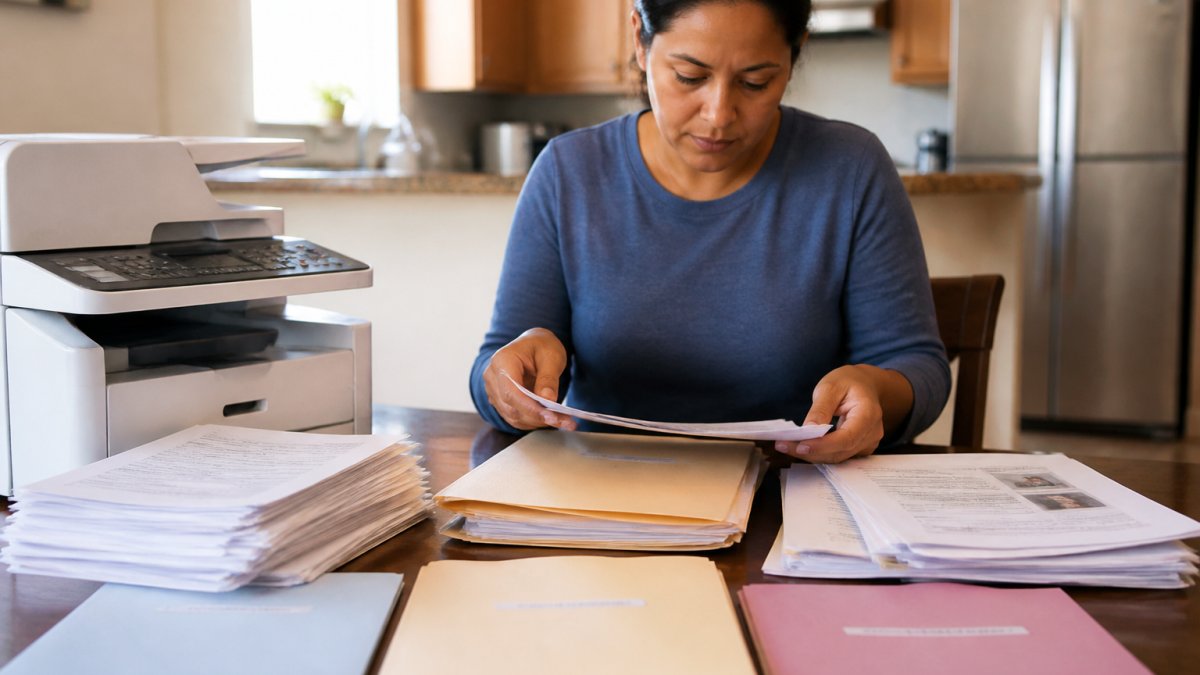
Before you mail the packet, sort documents into two folders: one for what you submit with Form N-400 and one for what you bring to the interview. Labeling the folders prevents the most common mix-up, sending originals you will need later or leaving certified copies at home on interview day.
Tax Returns, Transcripts, and Continuous Residence Proof
Continuous residence means you maintained a home in the United States without a long absence. Physical presence is the actual number of days you spent inside the country. Keep lease agreements, utility bills, and employment records ready if either is questioned. Tax transcripts are often the simplest way to show both residence and good moral character at once. (Source: USCIS Document Checklist M-477)
Court Records, Criminal History, and Selective Service
Certified court records should carry the clerk’s seal and show the final disposition for every arrest or citation. If a record is sealed or expunged, disclose it anyway and explain the disposition; USCIS can often see it through background checks. For Selective Service, keep your registration acknowledgment or a status letter from the Selective Service System.
N-400 Travel History Documents: Trips Outside the United States
USCIS requires a list of every trip outside the United States since you became a lawful permanent resident. Record departure dates, return dates, and destinations for each absence.
Pull the dates from passport stamps, airline itineraries, and credit card statements. Approximate dates invite questions. If a trip lasted more than six months, expect USCIS to examine whether you broke continuous residence, and prepare evidence of your U.S. ties for that period.
Additional Evidence for N-400 When Records Are Missing
Some records simply do not exist anymore. Courts close, agencies purge files, and foreign registries lose paperwork. When a document is unavailable, USCIS accepts a written explanation describing what you requested, from whom, and what response you received.
Attach secondary evidence: sworn statements, old correspondence, or alternative government records. Never leave a required item blank without an explanation, because silence reads as an omission.
Sending a packet with a missing court disposition and no explanation is one of the most common reasons naturalization cases stall. USCIS issues a Request for Evidence, and the response window is short.
N-400 Interview Documents to Bring in Person
Bring originals of everything you submitted with the application, plus your current passport and Permanent Resident Card. The officer will review your travel history and may ask for updated tax transcripts.
Also bring the interview notice itself. Applicants who pass the English and civics tests still face delays when originals are missing at the interview, because the officer cannot verify copies on the spot.
How to Prepare Copies, Translations, and Certified Records
Most filing errors are not about which documents you need, they are about how you prepare them. USCIS publishes specific expectations for copies, certified records, and translations, and following them the first time avoids a Request for Evidence.
Copies Versus Originals
Send photocopies with the application unless USCIS specifically asks for an original. Print single-sided copies on plain paper at full size. Do not shrink, laminate, or staple documents in a way that damages them. Keep every original in a separate folder for the interview. A common pattern is for applicants to mail the only certified copy they have and then arrive at the interview without it.
Certified Court Records
Certified records from courts should carry the clerk’s seal and show the final disposition. If a court provides a letter stating that a record is unavailable, include that letter with your explanation. Do not substitute a personal letter for a certified record when the court can still produce one.
Translations
If a document is in a foreign language, attach a full English translation with the translator’s certification. USCIS rejects partial translations. The certification should state that the translator is competent to translate and that the translation is complete and accurate. You can translate your own documents if you are competent, but many applicants prefer a third-party translator to avoid questions.
When a Document Is Unavailable
Some records simply do not exist anymore. Courts close, agencies purge files, and foreign registries lose paperwork. When a document is unavailable, USCIS accepts a written explanation describing what you requested, from whom, and what response you received. Attach secondary evidence: sworn statements, old correspondence, or alternative government records. Never leave a required item blank without an explanation, because silence reads as an omission.
Keep a Complete Copy
Keep one complete copy of your entire packet for your own file, and note the mailing date. If USCIS issues a Request for Evidence, you will need to know exactly what you sent and when.
- Photocopy of both sides of the Permanent Resident Card
- Passport-style photo taken within 30 days
- Filing fee in the accepted form
- Marriage certificate or divorce decrees, if applicable
Frequently Asked Questions
Do I need to submit a copy of my Green Card with Form N-400?
Yes. USCIS asks all applicants to send a photocopy of both sides of their Permanent Resident Card with the application. Copy the front and the back on separate pages so nothing is cut off, and keep the original card safe for your interview. If your card is expired or lost, say so in a cover letter and include any replacement receipt or other proof of lawful permanent resident status you have, then bring the original to the interview.
What additional evidence should I provide for N-400 if I have a criminal record?
Send certified court records for every arrest, citation, charge, and disposition, even ones that were dismissed or expunged. That means the charging document, the plea or judgment, and proof the sentence was completed. If you were arrested but never charged, include a police report or a letter from the court confirming no charges were filed. Disclose everything on the form. An omission looks worse than the original incident, and a qualified immigration attorney can review how each record affects good moral character.
Do I need to submit documents for every trip outside the United States?
Not for every trip. The N-400 travel history section asks you to list all trips taken outside the United States in the past five years, or three if you file as a spouse of a U.S. citizen. You only attach extra evidence, such as passport stamps, flight itineraries, or entry and exit records, when a trip was long or when USCIS asks. Keep a simple list of dates and destinations for your own records, and bring it to the interview.
What N-400 interview documents should I bring to the naturalization interview?
Bring your interview notice, your Permanent Resident Card, a state ID or driver’s license, your passport, and any travel documents. Add originals of everything you photocopied with the application, including marriage certificates, divorce decrees, and tax transcripts. If you have a pending name change, bring the court order. USCIS may also request updated evidence of continuous residence. Bring more than you think you need; missing originals can delay a decision.
What can I do if a required document is unavailable?
Try the issuing agency first. Courts, vital records offices, and the IRS can often supply certified copies or transcripts for a fee. If a record truly cannot be obtained, write a signed statement explaining what the document was, why it is unavailable, and what you did to find it. Attach secondary evidence such as affidavits from people with knowledge of the event or older government records. USCIS decides case by case, so a clear explanation helps more than leaving the item blank.