


Table of Contents
- Step 1: Determine Your Eligibility and Visa Category
- Step 2: Secure an Employer Sponsor and Understand the LCA Process
- Step 3: File Form I-129 and Meet H-1B Visa Requirements 2026
- Step 4: Complete Form DS-160 and Attend Your Consulate Interview
- Understanding US Work Visa Processing Times
- The Employment-Based Green Card Process: Moving from Temporary to Permanent
- Common Mistakes to Avoid in Your Work Visa Application
- Frequently Asked Questions
Last Updated: September 13, 2026
Step 1: Determine Your Eligibility and Visa Category
Getting a work visa for the US starts with one question: which category fits your background? Most applicants fail not from lack of qualifications but from picking the wrong classification.
A work visa is a nonimmigrant visa that authorizes a foreign national to accept employment in the United States for a specific employer, period, and purpose. The two main paths are temporary (nonimmigrant) and permanent (immigrant). Choosing correctly determines your timeline, fees, and whether your family can join you.
Temporary vs. Permanent Employment Visas
Temporary visas let you work for a set period and are tied to a specific petitioner. Common categories include the H-1B for specialty occupations, L-1 for intracompany transfers, and O-1 for extraordinary ability. Permanent employment-based visas lead to a green card and lawful permanent resident status.
Temporary categories process faster but require you to leave or extend when the period ends. Permanent categories take longer and involve labor certification, but offer a path to stay indefinitely.
Self-Petitioning Pathways: Who Qualifies Without an Employer
Not every applicant needs a company to sponsor them. The EB-2 National Interest Waiver allows certain advanced-degree professionals to self-petition if their work serves a national interest. EB-1A covers extraordinary ability in sciences, arts, education, business, or athletics, and O-1 visas also permit a petitioner to file on the beneficiary’s behalf in some cases.
Self-petitioning removes the employer bottleneck, but the evidentiary bar is high: you must document sustained acclaim most applicants cannot produce.
A common mistake is assuming “advanced degree” alone qualifies you for an EB-2 NIW. In practice, the deciding factor is whether you can show your work benefits the country beyond your employer’s bottom line.
Step 2: Secure an Employer Sponsor and Understand the LCA Process
Employer sponsorship is the backbone of most work visa applications. The employer acts as petitioner and files on behalf of the foreign national, the beneficiary. Without a willing sponsor, most temporary categories are closed.
The Role of Employer Sponsorship
The sponsoring employer must demonstrate a genuine job offer and the ability to pay the prevailing wage. For H-1B petitions, the employer also attests that hiring the foreign worker will not undercut wages or working conditions for similarly employed workers.
Department of Labor (DOL) Certification and Prevailing Wage
Before filing certain petitions, the employer must obtain a Labor Condition Application through the Department of Labor. The LCA confirms the employer will pay the higher of the actual or prevailing wage for the occupation in that location. For permanent employment-based cases, the employer typically needs a labor certification first, proving no qualified US worker is available.
The Department of Labor’s Foreign Labor Certification guidance outlines the attestation requirements employers must meet. Get the wage determination wrong and the entire petition can collapse.
| Visa Path | Employer Sponsor Required | Labor Certification | Leads to Green Card |
|---|---|---|---|
| H-1B | Yes | LCA only | No, but dual intent allowed |
| L-1 | Yes | No | No |
| O-1 | Yes, or agent | No | No |
| EB-2 NIW | No, self-petition | Waived | Yes |
| EB-3 | Yes | Yes | Yes |
Step 3: File Form I-129 and Meet H-1B Visa Requirements 2026
Form I-129, the Petition for a Nonimmigrant Worker, is filed by your employer with US Citizenship and Immigration Services (USCIS) for most temporary worker categories, including H-1B, L-1, O-1, and TN. It is not filed with a consulate, and not filed by you. The petition establishes three things: the job qualifies under the requested classification, you meet its minimum requirements, and the employer-employee relationship is genuine.
What the H-1B Actually Requires
H-1B visa requirements 2026 remain centered on four elements:
- A specialty occupation. The role must normally require at least a bachelor’s degree or its equivalent in a specific field. Three years of progressive, directly relevant work experience can substitute for one year of university study under the standard USCIS formula, but the employer must document that equivalence.
- A qualifying degree. Your degree should relate to the duties, or you must show a combination of education and experience that maps to the role.
- A valid employer-employee relationship. The employer must control your hours, location, duties, and supervision. Staffing arrangements and third-party placements draw extra scrutiny.
- A certified Labor Condition Application. The employer must have an approved LCA covering the worksite and wage before the I-129 is filed.
The Registration Lottery and the Cap
The H-1B is subject to an annual numerical cap: 65,000 visas in the regular cap, plus 20,000 reserved for beneficiaries with a master’s degree or higher from a US institution. Certain employers, institutions of higher education, affiliated nonprofits, and nonprofit or governmental research organizations, are cap-exempt, meaning they can file an H-1B at any time of year without the lottery. This is one of the most underused strategies for applicants who cannot wait out the cap.
For cap-subject employers, the process runs on a fixed calendar:
- Registration. The employer submits an electronic registration for each beneficiary during the designated window, which in recent years has opened in March. Registration is free at this stage.
- Selection. USCIS runs a random selection if registrations exceed the cap. Selection is not merit-based, a stronger resume does not improve your odds.
- Filing. If selected, the employer has a limited window (typically 90 days) to file the full I-129 with supporting evidence.
- Start date. Approved cap-subject petitions generally carry an October 1 start date, the beginning of the federal fiscal year.
Because demand has historically exceeded supply, selection is never guaranteed even for highly qualified applicants, and employers often register the same beneficiary across multiple years.
Premium Processing and Filing Logistics
USCIS offers optional premium processing for many I-129 classifications, including H-1B, L-1, and O-1. For an additional fee, USCIS guarantees a response within a set timeframe, 15 business days for most categories, though the exact window and fee are adjusted periodically and should be confirmed against current USCIS Form I-907 instructions. Premium processing buys speed, not approval.
The filing must include the approved LCA, a support letter describing the duties and specialty nature of the role, evidence of your qualifications (diplomas, transcripts, credential evaluations for foreign degrees), and the applicable filing fee. Fee amounts change; check the current USCIS fee schedule rather than an older guide.
Change of Status vs. Consular Processing
If you are already in the United States in a valid nonimmigrant status, for example, an F-1 student on Optional Practical Training, the employer can request a change of status on the same I-129 rather than consular processing. Approval lets you begin work on October 1 without leaving the country. If you are abroad, or travel while the petition is pending, you will generally need consular processing instead.
For a work visa, the petition is only the first half of the process. Approval of the I-129 does not grant status by itself; it authorizes the consular step that follows, or the change of status if you are already here. Background checks conducted during this final adjudication phase often reveal past infractions that necessitate clearing criminal records to ensure your eligibility remains intact.
If your goal is to start work sooner than October, look at cap-exempt employers first. A university, teaching hospital, or affiliated research institute can sponsor an H-1B outside the lottery entirely, the same petition, none of the waiting.
Step 4: Complete Form DS-160 and Attend Your Consulate Interview
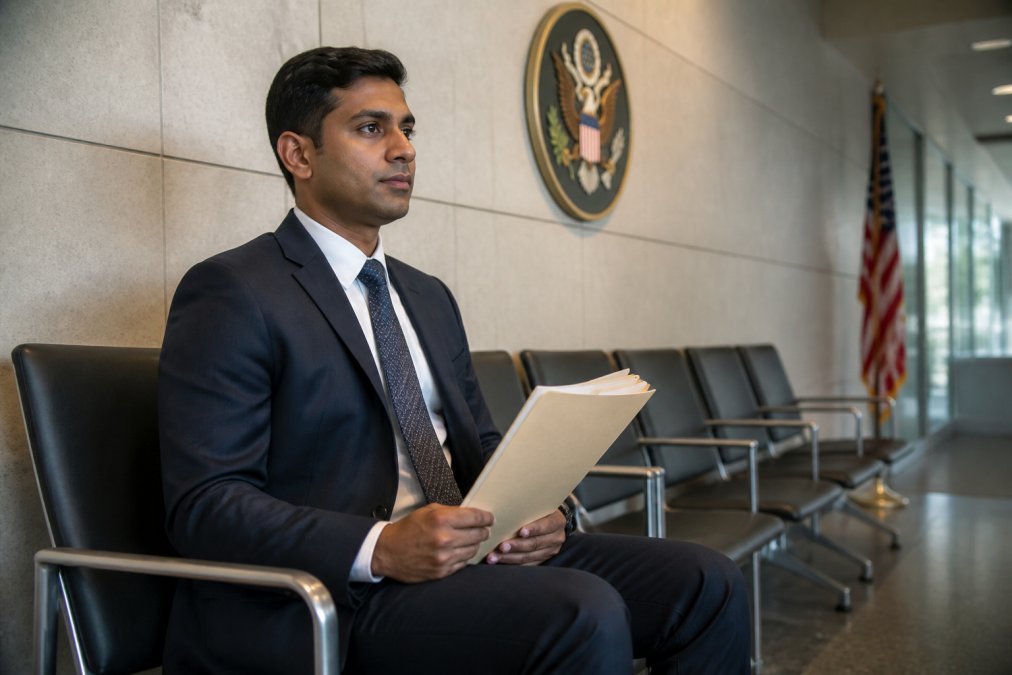
After petition approval, the beneficiary completes Form DS-160, the online nonimmigrant visa application, and schedules an interview at the consulate or embassy with jurisdiction over their residence. The travel.state.gov nonimmigrant visa process confirms that most applicants between certain ages must appear in person.
Bring the approval notice, the DS-160 confirmation page, your passport, and supporting documents. Answer questions consistently with your petition, inconsistencies between the DS-160 and the I-129 are a leading cause of refusal.
Biometrics and the Visa Interview
Most applicants complete biometrics, fingerprints and a photograph, before or at the interview. The consular officer then determines eligibility and, if approved, issues the visa. Expect administrative processing in some cases, which adds time you cannot control.
Do not book travel before the visa is physically in your passport. Approval at the interview is not the same as issuance, and administrative processing can delay it without notice.
Understanding US Work Visa Processing Times
US work visa processing times vary widely by category, service center, and consulate, and no single number applies to every applicant. Below is the sequence most applicants move through, what drives each delay, and what happens after the visa is issued.
| Stage | Typical Range | What Drives the Delay |
|---|---|---|
| LCA certification | About 7 business days | Wage determination accuracy, employer response to DOL questions |
| I-129 petition (regular) | Weeks to several months | Service center backlog, request for evidence (RFE) |
| I-129 petition (premium) | 15 business days for most categories | Guaranteed response window, not guaranteed approval |
| Consular interview scheduling | Weeks to months after the petition is approved | Post volume, seasonal demand, security checks |
| Administrative processing | Variable, days to months | Additional vetting, name checks, document verification |
| Visa issuance | Days after approval | Printing and passport return logistics |
The USCIS processing time tool lets you check current estimates by form and office. Treat any single number you hear as a snapshot, not a promise. The travel.state.gov visa wait times page publishes current interview appointment wait times by consulate.
Fees You Should Budget For
Fees change, so treat the categories below as what to plan around rather than fixed figures, always confirm against the current USCIS fee schedule and the State Department’s fee page before you file:
- I-129 base filing fee, varies by classification and employer size.
- Asylum Program Fee, an additional employer-paid fee introduced in recent years for most I-129 and I-140 filings.
- Fraud prevention and detection fee, applies to certain H-1B and L-1 petitions.
- American Competitiveness and Workforce Improvement Act (ACWIA) fee, applies to H-1B petitions, with a lower rate for small employers.
- Premium processing fee, optional, paid on top of the base filing fee.
- DS-160 consular application fee, paid by the beneficiary, non-refundable.
- Reciprocity fee, applies to nationals of certain countries only.
Typically the employer covers petition-related fees and the beneficiary covers the consular fee. The split is negotiable but constrained by law for some categories.
What Happens After Approval, The Step Most Guides Skip
Visa issuance is not the finish line. Several obligations begin immediately:
- Social Security number. If you do not already have one, apply after you arrive and can show work authorization. You generally cannot apply from abroad.
- Tax withholding and filing. You become subject to US tax rules on your US-source income, and your tax residency status (nonresident alien vs. resident alien) is determined by the substantial presence test, not your visa type. Many visa holders must file Form 1040-NR, and some treaty countries allow reduced withholding under a tax treaty.
- Labor rights. You have the same wage, hour, safety, and anti-discrimination protections as US workers. The LCA your employer filed is a public document you can request. Retaliation for asserting your rights is prohibited.
- Maintaining status. Keep your I-94 record current, report material employment changes to USCIS where required, and avoid gaps between authorized periods of stay.
Family Members and Their Timelines
Spouses and unmarried children under 21 may be eligible for derivative status in many categories, H-4 for H-1B dependents, L-2 for L-1 dependents, and O-3 for O-1 dependents. Derivative applications are typically filed alongside the principal petition or at the consulate at the same time, so the family’s timeline tracks the principal applicant’s. Work authorization is category-specific: L-2 spouses are generally work-authorized incident to status, while H-4 spouses may apply only if the H-1B principal has an approved I-140 or has been granted H-1B status beyond the six-year limit under AC21.
Remote Work and Location Compliance
Working remotely for a US employer from outside the country is not the same as holding a US work visa, and it does not require one, but it also does not build US immigration status. Once you are in the United States on a work visa, your authorized worksite matters: the LCA and petition list a specific location, and working elsewhere for more than a short period can require a new LCA or amended petition. Treating a tourist admission as permission to work remotely for a US employer is a compliance risk, not a loophole.
Do not book travel before the visa is physically in your passport. Approval at the interview is not the same as issuance, and administrative processing can delay it without notice.
Processing time is the part you cannot control; the parts you can control are filing early, choosing a cap-exempt employer if the lottery is a risk, and preparing your post-arrival tax and Social Security steps before you land.
The Employment-Based Green Card Process: Moving from Temporary to Permanent
The employment-based green card process converts a temporary stay into permanent resident status. It usually begins with labor certification, then an I-140 immigrant petition, followed by status adjustment or consular processing. Categories such as EB-2 NIW skip labor certification.
Priority dates matter here. When demand exceeds the annual quota, applicants wait for a visa number, and that wait can stretch for years in certain categories and countries of chargeability. Family members may accompany you, but eligibility rules differ by category.
Common Mistakes to Avoid in Your Work Visa Application
Denials often trace back to preventable errors: mismatched job duties between the LCA and the petition, missing signatures, and inconsistent interview answers. Filing under the wrong category is another costly error, since a denial on one classification does not automatically convert to another. Compliance does not end at approval: post-approval onboarding, maintaining status, and reporting changes to your employer all affect your legal standing, and working outside your approved worksite can raise compliance questions.
The strongest applications are consistent from start to finish: the job description, the wage attestation, the petition, and your interview answers should tell one coherent story.
A work visa application rewards preparation and punishes guesswork, and the margin between approval and denial is often a single inconsistent document. If you are navigating sponsorship, labor certification, or the transition to permanent residence, Kanu & Associates, P.C. can provide expert legal representation. Our immigration team explains your options clearly, helps you build a consistent record, and supports you through the consulate stage and beyond. Contact us to get started and move forward with confidence.
Frequently Asked Questions
What is the easiest U.S. work visa to get?
There is no single ‘easiest’ work visa because eligibility depends on your qualifications, employer, and country of citizenship. The H-1B is common for professionals but subject to a lottery. The L-1 is for intracompany transfers. The O-1 is for individuals with extraordinary ability. Each has different requirements. A consultation with an immigration attorney can help you identify which category fits your situation best.
Can I get a U.S. work visa without a job offer?
Most employment-based work visas require a job offer from a U.S. employer. However, some categories allow self-petitioning. For example, the EB-1A extraordinary ability category and the National Interest Waiver (EB-2 NIW) allow individuals to petition for themselves without a specific employer. These pathways have high evidentiary standards. An attorney can evaluate whether your achievements meet the criteria.
How does the H-1B lottery system work for 2026 applicants?
The H-1B lottery is a random selection process for cap-subject petitions. U.S. employers register candidates electronically during a designated registration period. If selected, the employer can file Form I-129. The number of registrations typically far exceeds the annual cap, so selection is not guaranteed. Planning alternative visa categories or timing your application strategically can help. Consult an immigration attorney to understand your options.
What are the primary categories for US employment-based visas?
Employment-based visas fall into two main groups: temporary (nonimmigrant) and permanent (immigrant). Common temporary categories include H-1B for specialty occupations, L-1 for intracompany transferees, and O-1 for extraordinary ability. Permanent categories include EB-1 (priority workers), EB-2 (advanced degree or exceptional ability), and EB-3 (skilled workers). Each has distinct eligibility criteria and processing paths.