


Table of Contents
- Understanding Form N-400 and Eligibility Requirements
- Gathering Required Supporting Documents and Evidence
- Step-by-Step Filing Instructions for Form N-400
- Online vs. Paper N-400 Filing: Which Method to Choose
- Filing Fees and Payment Methods
- Common N-400 Errors to Avoid
- USCIS N-400 Processing Times and What to Expect After Filing
- Reviewing Your Application and Correcting Mistakes Before Submission
- Frequently Asked Questions
Last Updated: September 20, 2026
Understanding Form N-400 and Eligibility Requirements
Form N-400 is the official Application for Naturalization filed with U.S. Citizenship and Immigration Services (USCIS). This form is how permanent residents apply to become U.S. citizens. Before you file form N-400, you must meet specific eligibility requirements set by federal law.
To file form N-400, you typically need to have held a green card for at least five years. However, if you’re married to a U.S. citizen, the requirement drops to three years. You must also demonstrate continuous residence in the United States, physical presence for the required period, and good moral character. The civics test and English language assessment are also part of the naturalization process.
At Kanu & Associates, P.C., we help clients understand whether they’re ready to file and guide them through every step. Many applicants worry about making mistakes that delay their case. The good news: understanding the requirements upfront prevents costly errors.
Key eligibility factors include:
- Green card status for the required time period
- Continuous U.S. residence without extended absences
- Physical presence in the country for specified months
- Ability to pass the civics and English tests
- Good moral character (no serious criminal history)
- Intent to support the U.S. Constitution
Gathering Required Supporting Documents and Evidence
Filing form N-400 requires extensive supporting documentation. USCIS reviews these documents carefully to verify your eligibility and background. Missing or incomplete evidence is one of the top reasons applications get rejected or delayed.
Start by gathering documents that prove your permanent resident status. You’ll need your green card and any travel documents. Next, collect evidence of continuous residence: utility bills, lease agreements, tax returns, employment letters, and bank statements from the past five years. These show you’ve maintained a home in the United States without extended time abroad.
The N-400 supporting documents checklist should include:
- Green card (copy of front and back)
- State ID or driver’s license
- Passport and travel documents
- Tax returns for the past five years
- W-2 forms or employment verification letters
- Utility bills or lease agreements (recent)
- Bank statements showing U.S. residence
- Marriage certificate (if applicable)
- Divorce decrees (if previously married)
- Police clearance from any country where you lived
- Medical examination results (Form I-693)
- Biometrics appointment notice
Evidence of physical presence matters significantly. USCIS wants to see that you’ve been in the country for the required number of days. Keep records of any trips outside the U.S., including dates and destinations. If you took extended trips, document the reason and duration.
Good moral character requires careful documentation too. If you have any traffic violations, arrests, or other legal issues, disclose them with explanation. Hiding problems creates bigger issues later.
Step-by-Step Filing Instructions for Form N-400
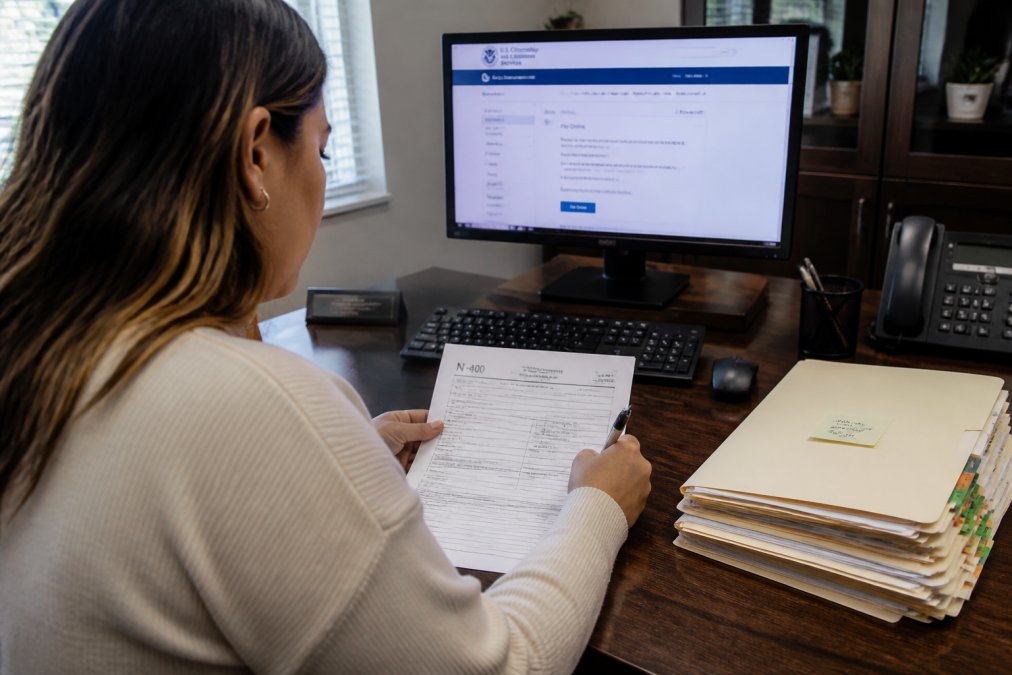
Filing form N-400 involves completing the application accurately, gathering evidence, and submitting everything to USCIS. The process has specific steps you must follow in order.
Step 1: Verify Your Eligibility
Before you start, confirm you meet all requirements. Check your green card issue date to calculate when you’re eligible. If you’re married to a U.S. citizen, document that status. Review your travel history to ensure you haven’t been outside the country for more than six months at a time (for the standard five-year track).
Step 2: Complete Form N-400 Accurately
Read the form instructions carefully. The N-400 application asks for personal information, residence history, employment, family details, and background information. Answer every question. If a question doesn’t apply, write “N/A” rather than leaving it blank. USCIS interprets blank spaces as incomplete applications.
Pay special attention to dates. Use the exact format requested. Double-check addresses and spelling of names. Small errors can trigger requests for additional information or even denials.
Step 3: Organize Your Supporting Evidence
Create a folder for each section of required documents. Label them clearly. Make copies of everything, you’ll keep originals and submit copies. Arrange documents in the order USCIS requests. This makes the application package easy for officers to review.
Step 4: Prepare Your Biometrics Appointment
USCIS will schedule you for biometrics (fingerprints and photos). When you receive your appointment notice, go on the scheduled date and time. Bring your green card and a valid ID. Biometrics results are required before your naturalization interview.
Step 5: Submit Your Application Package
Decide whether to file online or by mail. Online filing is faster and lets you track your case in real time. Mail filing takes longer but works if you’re not comfortable with online submission. Include the correct filing fee or fee waiver form.
Completing Each Section Accurately
Form N-400 has multiple sections. Each requires careful attention. The Part 1 section asks for your legal name and any other names you’ve used. If you’ve changed your name, provide documentation of the legal change.
Part 2 covers your residence history. List every address where you’ve lived for the past five years, including dates. If you moved frequently, this section takes time. Be precise with dates, USCIS verifies this information.
Part 3 addresses your time outside the United States. List every trip of more than 24 hours. Include the destination country, departure date, and return date. This section is critical. Extended absences can affect your eligibility, so accurate reporting matters.
Part 4 asks about your family. List your spouse (if married), children, and parents. Provide their names, dates of birth, and current residence. If any family members are also applying for naturalization, note that.
Part 5 covers your employment history. List jobs for the past five years with employer names, dates, and job titles. If you were self-employed, explain your business. Gaps in employment are okay if you can explain them (education, caregiving, etc.).
Part 6 asks about your background. This is where you disclose any arrests, convictions, or legal issues. Be honest. USCIS will find records anyway. Disclosure with explanation is much better than discovery of hidden information.
Passport-Style Photo Requirements
USCIS has specific requirements for the passport-style photos you must submit with form N-400. Photos that don’t meet standards get rejected, delaying your application.
Your photos must be:
- Taken within the last six months
- 2×2 inches in size
- Color or black and white
- Printed on glossy photo paper
- Showing your full face, head on, with a plain white or off-white background
- With your eyes open and looking directly at the camera
- Without glasses, hats, or head coverings (unless for religious reasons)
- Without heavy makeup or filters
Take your photos at a professional photo studio. Dollar stores and pharmacy photo departments often provide USCIS-compliant photos. Ask the photographer to confirm they meet USCIS standards. Write your A-number (alien registration number) on the back of each photo with a pencil.
Online vs. Paper N-400 Filing: Which Method to Choose
You can file form N-400 online through the USCIS portal or by mail. Each method has advantages and drawbacks.
Online filing lets you submit your application and documents electronically. You pay the fee online and receive a receipt number immediately. You can track your case status in real time through your USCIS account. Processing times are often faster than mail filing. The biggest advantage: you have a record of exactly what USCIS received.
Paper filing means printing the form, gathering documents, and mailing everything to the USCIS address for your jurisdiction. Mail filing takes longer, your package must arrive, be logged in, and be processed. Tracking is slower. However, some applicants prefer mail if they’re uncomfortable with technology or have complex documents that don’t scan well.
For most applicants, online filing is the better choice.
Filing Fees and Payment Methods
USCIS charges a filing fee for form N-400. The fee amount is set by federal regulation and changes periodically. Check the current fee on the official USCIS website before you file.
Payment methods for the filing fee include:
- Credit card (online filing)
- Debit card (online filing)
- Check or money order (mail filing)
- Fee waiver approval (if eligible)
Common N-400 Errors to Avoid
Mistakes on form N-400 are common and often preventable. Understanding the most frequent errors helps you avoid them.
USCIS N-400 Processing Times and What to Expect After Filing
After you submit form N-400, USCIS processes your application in stages. Understanding the timeline helps you know what to expect.
Reviewing Your Application and Correcting Mistakes Before Submission
Before you submit form N-400, review everything carefully. This is your last chance to catch errors.
Frequently Asked Questions
What are the most common N-400 mistakes that get applications rejected?
The most frequent errors include incomplete sections, missing signatures, incorrect passport-style photos, outdated alien registration numbers, and failure to provide required supporting documentation. Leaving fields blank, using different names than shown on your green card, or submitting illegible copies of documents also causes rejections. Review your entire application against the official checklist before submission, and consider having an immigration attorney review it first to catch errors you might miss.
Is it better to file my N-400 online or by mail?
Online filing through USCIS’s portal is generally faster and provides immediate confirmation of receipt, reducing processing delays. You receive a receipt number instantly and can track your application status in real time. Paper filing requires mailing to a specific USCIS address and takes longer to process. Online filing also reduces the risk of documents being lost in transit. However, if you’re uncomfortable with digital filing or have technical limitations, paper filing remains a valid option, just allow extra time for mailing and initial processing.
How long does USCIS take to process an N-400 application?
USCIS N-400 processing times vary by location. Some cases are processed faster, while others may take longer depending on background check complexity, local office workload, and whether additional evidence is requested. After your interview, a decision usually comes within a few weeks. You can check your specific case status through USCIS’s online case status tracker using your receipt number, which you receive immediately after filing.
What supporting documents do I absolutely need for my N-400 application?
Essential documents include your green card, passport, state-issued ID, birth certificate, marriage certificate (if applicable), divorce decrees (if applicable), tax returns for the past five years, evidence of physical presence in the country, and proof of residence such as utility bills or lease agreements. You’ll also need passport-style photos, evidence of good moral character, and documentation of any trips outside the country. Review the official N-400 supporting documents checklist from USCIS before gathering materials to ensure you don’t miss anything critical.