


Table of Contents
- What to Expect at Your Immigrant Visa Interview
- Immigrant Visa Interview Document Checklist
- Common Immigrant Visa Interview Questions 2026
- Preparing Your Affidavit of Support and Financial Documents
- Security Screening and Biometrics
- Hiring an Immigration Attorney for Visa Interviews
- Final Preparation: Etiquette, Stress Management, and Next Steps
- Frequently Asked Questions
Last Updated: September 18, 2026
What to Expect at Your Immigrant Visa Interview
Your immigrant visa interview is a formal conversation with a consular officer who assesses your eligibility by reviewing your petition, documents, and answers to determine whether you meet legal requirements and pose no security or health risks.
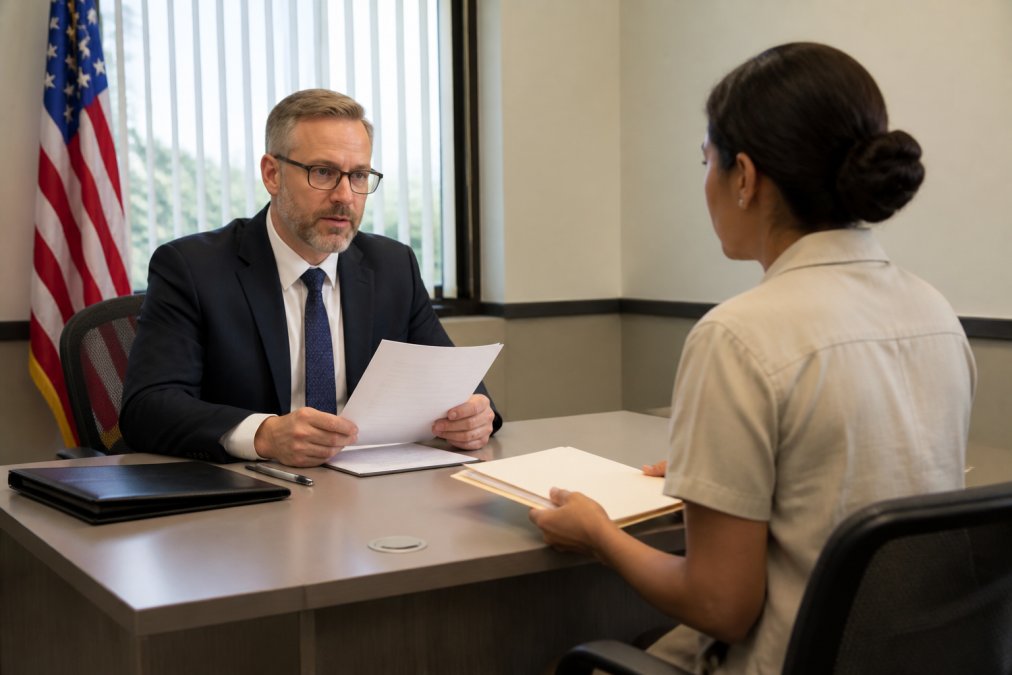
The interview typically lasts 15 to 30 minutes. The officer asks about your background, relationship to your petitioner, work history, and immigration intent to confirm your petition information matches your spoken answers.
Most interviews follow a predictable structure: the officer reviews your file and asks opening questions, you answer about your personal history and eligibility, the officer discusses medical and security results, and explains next steps. The tone is professional; your job is to answer honestly and clearly.
Arrive 15 minutes early. Bring all original documents even if you’ve already submitted copies. The officer may ask to see originals to verify authenticity.
Immigrant Visa Interview Document Checklist
Bring every document listed below to your interview. Missing documents can delay your case or result in denial.
Required Civil Documents:
- Valid passport
- Birth certificate (original or certified copy)
- Marriage certificate (if applicable)
- Divorce decrees or death certificates (if previously married)
- Police clearance certificate from your home country
- Medical examination results (Form I-693, completed by USCIS-designated physician)
Affidavit of Support and Financial Documents:
- Form I-864 (Affidavit of Support) signed by your sponsor
- Sponsor’s tax returns for the last 3 years
- Sponsor’s recent pay stubs or employment verification letter
- Bank statements showing liquid assets (if needed)
- Proof of sponsor’s citizenship or permanent residency status
Visa and Immigration Documents:
- Appointment confirmation notice from the National Visa Center (NVC)
- DS-160 confirmation page (your online visa application)
- Visa fee payment receipt
- Any correspondence from the U.S. Embassy or Consulate
Supporting Evidence:
- Photos of you with your petitioner (if family-based immigration)
- Proof of housing arrangements in the United States
- Employment offer letter (if job-based immigration)
- School enrollment letter (if immigrating for education)
- Any documents addressing grounds for inadmissibility
Make Copies:
- Create two sets and label each document with your name and case number
Do not bring original documents from your home country unless the consular officer specifically requests them. Originals can be lost or damaged. Bring certified copies instead.
Common Immigrant Visa Interview Questions 2026
Consular officers ask questions to verify your identity, confirm eligibility, and assess immigration intent.
Questions About Your Background:
- “Tell me about yourself and your family.”
- “What is your current occupation and how long have you worked there?”
- “Why are you immigrating to the United States?”
- “Do you have any family members already in the United States?”
- “Have you ever been arrested or convicted of a crime?”
Questions About Your Petitioner (if applicable):
- “How do you know your petitioner?”
- “When did you last see your petitioner in person?”
- “How often do you communicate with your petitioner?”
- “What is your petitioner’s occupation and income?”
- “Why is your petitioner sponsoring you?”
Questions About Your Immigration Intent:
- “Where will you live in the United States?”
- “Do you plan to work? If so, what type of work?”
- “How long do you plan to stay in the United States?”
- “Have you visited the United States before?”
- “Do you have ties to your home country you plan to maintain?”
Questions About Medical and Security Matters:
- “Have you had any serious illnesses or medical conditions?”
- “Have you ever used illegal drugs?”
- “Have you ever been involved in military service or paramilitary activities?”
- “Do you have any outstanding debts or legal obligations?”
Answer honestly and clearly. If you don’t understand a question, ask the officer to rephrase it.
Consular officers conduct interviews to verify your eligibility and intent. They are not trying to trick you. Answer honestly, stay calm, and provide straightforward responses.
Preparing Your Affidavit of Support and Financial Documents
Your sponsor completes Form I-864 (Affidavit of Support) to prove they can financially support you and prevent you from becoming a public charge. This legally binding commitment lasts until you become a U.S. citizen or earn 40 quarters of Social Security credits.
2026 Income Requirements and Poverty Guidelines
The sponsor must meet income requirements based on household size and federal poverty guidelines. For 2026, the threshold is approximately 125% of the federal poverty line for most cases.
Example 2026 income thresholds (125% of poverty line): single sponsor with one immigrant, approximately $16,500 annually; sponsor with spouse and one immigrant, approximately $22,000 annually. Consult the Department of State’s current poverty guidelines for your specific household size and state.
If your sponsor’s income falls below the requirement, they can use liquid assets (generally 3 times the shortfall), add a joint sponsor, or provide evidence of recent income increase. (Source: U.S. Citizenship and Immigration Services (USCIS))
What the Sponsor Must Provide
- Form I-864: Completed, signed, and notarized (false statements are a federal crime).
- Tax Returns: Last 3 years of federal income tax returns; self-employed sponsors must provide Schedule C.
- Recent Pay Stubs: Last 30 days of pay stubs or employment verification letter.
- Bank Statements: If using assets, provide statements dated within 30 days of the interview.
- Proof of Status: Copy of sponsor’s U.S. passport, naturalization certificate, or green card.
Common Financial Document Errors That Cause Delays
Avoid these errors: mismatched income figures, missing recent pay stubs, undated or incomplete bank statements, outdated documents, missing joint sponsor documentation, and unexplained multiple income sources. Reconcile discrepancies and submit documents within 30 days of your interview.
Joint Sponsor Requirements and Mechanics
A joint sponsor is a U.S. citizen or permanent resident who co-signs if the primary sponsor’s income is insufficient. Both are legally liable. The joint sponsor must be at least 18, a U.S. citizen or permanent resident, reside in the U.S., meet the 125% poverty guideline, and complete a separate Form I-864. Both sponsors should attend the interview or provide notarized statements confirming their commitment.
What Happens If the Sponsor’s Financial Situation Changes
If your sponsor’s income decreases or employment changes before your interview, disclose this to the consular officer. Provide updated pay stubs, explain the reason, and if income is now below the requirement, add a joint sponsor or use assets to compensate. The Form I-864 is binding even after visa approval; the sponsor remains responsible for your support until you become a U.S. citizen or meet the 40-quarter work requirement.
What You Must Bring to the Interview
- Signed Form I-864 (and joint sponsor Form I-864 if applicable)
- Copies of all financial documents your sponsor submitted with the visa petition
- Updated financial documents since the petition was filed (recent pay stubs, updated bank statements, new tax returns if filed)
- Proof that your sponsor is a U.S. citizen or permanent resident
- If a joint sponsor is involved, their complete financial package and proof of status
- Any written explanation of changes in the sponsor’s financial situation
The consular officer will review these documents to confirm your sponsor can meet their legal obligation. If documents are missing, incomplete, or inconsistent, the officer may request them before deciding.
Do not ask your sponsor to overstate their income or assets on the Form I-864. Doing so is fraud and can result in criminal charges, visa denial, and deportation. Be honest about your sponsor’s financial capacity.
Security Screening and Biometrics
Before your interview, you complete security screening and biometrics collection to verify your identity and check for security concerns. You receive a notice to appear for fingerprinting and photography at a USCIS Application Support Center or U.S. Embassy or Consulate. Your fingerprints, photograph, and signature are recorded and checked against criminal and immigration databases. The process takes 15 to 30 minutes; results are typically available within 2 to 4 weeks. If security screening raises concerns, the consular officer will discuss them at your interview.
Hiring an Immigration Attorney for Visa Interviews
An immigration attorney can guide you through the process, review your documents, and represent you at your interview. Kanu & Associates, P.C. provides honest, practical guidance tailored to your specific situation.
If you have any criminal history, prior visa denials, or concerns about admissibility, hire an attorney early. Early intervention can prevent costly delays or denials.
Final Preparation: Etiquette, Stress Management, and Next Steps
Your mindset and preparation in the final days matter.
Stress Management Strategies
Interview Etiquette and Demeanor
What Happens Immediately After Your Interview
Approved:
The officer will say “Congratulations.” You will receive a written approval notice, instructions for passport processing, a timeline for passport return (typically 3-7 business days), and information about visa validity (usually 6 months).
Managing Emotions After the Interview
Remember: the consular officer is not your adversary. They conduct hundreds of interviews and follow a legal process. Your job is to answer honestly, communicate clearly, and let the facts speak for themselves.
Frequently Asked Questions
What documents must I bring to my immigrant visa interview?
Bring your passport, birth certificate, civil documents (marriage, divorce, or adoption certificates if applicable), medical examination results, police clearance, affidavit of support, financial documents proving the sponsor’s ability to support you, and employment history. Consular processing requires original documents and photocopies. Check your appointment confirmation letter for the complete list specific to your case, as requirements vary by visa category and country.
What are common immigrant visa interview questions in 2026?
Expect questions about your relationship to your sponsor, your work history and qualifications, your ties to your home country, your intent to immigrate permanently, and your admissibility to the United States. The consular officer may ask about your family, your plans after arrival, and details about your petition. Prepare honest, concise answers. Practice with a mock interview to build confidence and clarity.
Can I bring an attorney to my immigrant visa interview?
Yes, you can hire an immigration attorney to represent you during consular processing. An attorney can help you prepare for your interview and advise on admissibility concerns. Some applicants benefit from legal guidance, especially if there are complex circumstances or previous visa denials. Contact an immigration law firm to discuss whether representation is right for your situation.
How can I reduce stress and anxiety before my visa interview?
Prepare thoroughly by reviewing your documents, practicing interview answers, and understanding the process. Get adequate sleep the night before and arrive early to the appointment. Bring water and a small snack. Practice deep breathing or meditation to manage anxiety. Remember that consular officers conduct hundreds of interviews; they expect some nervousness. Focus on being honest, clear, and respectful during the interview.