


Table of Contents
- Why Your Immigrant Visa Document Checklist Matters
- 1. Passport and Travel Document Requirements
- 2. Civil Documents for Immigrant Visa Interview Success
- 3. Financial Evidence and Affidavit of Support Form I-864 Requirements
- 4. Medical Examination and Police Certificate Documentation
- How to File for Naturalization 2026: Beyond the Immigrant Visa
- Common RFE Triggers and How to Avoid Them
- Digital Document Organization for Your Visa Application
- Frequently Asked Questions
Last Updated: September 24, 2026
Why Your Immigrant Visa Document Checklist Matters
A complete immigrant visa checklist is the difference between approval and delays costing months or requests for evidence. A single missing document or poorly organized file can derail an otherwise strong application. (Source: U.S. Citizenship and Immigration Services (USCIS) website)
The immigrant visa process involves USCIS (initial petition), the National Visa Center (case processing), and a consular officer (final decision). Each step demands specific paperwork with varying interpretations of “complete.”
This guide covers critical documents for your immigrant visa checklist and strategies to organize them, plus how to avoid common mistakes that trigger requests for evidence.
1. Passport and Travel Document Requirements
Your passport is your entry ticket. Without a valid passport that won’t expire during visa processing, consular officers won’t schedule an interview.
What counts as valid:
- A passport valid for at least six months beyond your intended entry to the United States
- Original document (not a photocopy)
- All pages intact, including any visa stamps or amendments
If your passport expires while your case is pending, renew it before your interview, renewal takes weeks in some countries.
Bring the original passport and copies to your interview; consular officers verify it in person and keep copies in your file.
Check your passport expiration date against your case timeline NOW. If renewal is even a possibility, start that process immediately. A delayed passport renewal can push back your entire visa interview.
2. Civil Documents for Immigrant Visa Interview Success
Civil documents prove your identity and legal relationships, answering the consular officer’s first questions about who you are and whether your family relationship is legitimate.
Essential civil documents include:
- Birth certificate (original or certified copy)
- Marriage certificate (if married)
- Divorce decrees or death certificates (if previously married)
- Adoption papers (if applicable)
Civil documents must be originals or certified copies. If in another language, you’ll need certified English translations.
Certified translations take time, especially from countries with slow government offices. Start gathering and translating civil documents as soon as your petition is approved.
Consular officers compare civil documents to your DS-160 form and interview testimony. Discrepancies raise red flags, if your birth certificate shows a different name than your passport, provide legal documentation of the name change.
Missing or incomplete civil documents are among the top triggers for requests for evidence. A single missing divorce decree can delay your case by months while you track it down from another country. Gather these documents early.
3. Financial Evidence and Affidavit of Support Form I-864 Requirements
Financial evidence and Form I-864 (Affidavit of Support) prove that you or a sponsor has sufficient income to support you.
Your immigrant visa checklist must include:
- Form I-864 (Affidavit of Support) signed by your sponsor
- Tax transcripts for the sponsor (last three years)
- Employment verification letter
- Bank statements showing liquid assets
- Proof of property ownership (if claiming assets)
- W-2 forms or 1099s documenting income sources
The sponsor’s income must meet federal poverty guidelines, updated annually by USCIS. For 2026, guidelines are approximately $18,600 for a household of two and $38,000 for a household of four (varying slightly by state). The immigrant’s household size is added to the sponsor’s household size for calculation.
If income falls short, use a co-sponsor or claim assets totaling at least three times the shortfall (e.g., $10,000 shortfall requires $30,000 in documented assets).
What Counts as Income, and What Doesn’t
W-2 wages are straightforward. Self-employment income requires two years of tax returns plus a current profit-and-loss statement. Rental income requires lease agreements, proof of payment, and property tax statements. Social Security or pension income requires award letters.
Income that does NOT count: irregular gifts, one-time bonuses, unemployment benefits, or child support. USCIS requires stable, ongoing income for the affidavit’s ten-year obligation.
Asset Documentation and Valuation
Liquid assets count: bank accounts, money market accounts, certificates of deposit. Real estate equity requires a property appraisal or recent tax assessment. Retirement accounts and vehicles do not count.
For each asset, provide a bank statement (within 30 days) or property deed plus appraisal.
Request IRS tax transcripts online at irs.gov (Account Transcript) rather than by mail. Online requests are processed in 5-10 business days. Mail requests take 4-6 weeks. Have your sponsor’s Social Security number and filing status ready when you request.
Financial evidence rejections are among the top reasons for requests for evidence. A single missing tax transcript or an employment letter that doesn’t state salary will trigger an RFE and delay your case by 30-60 days. Verify every document meets USCIS requirements before submission.
::: (Source: Department of State’s Bureau of Consular Affairs)
4. Medical Examination and Police Certificate Documentation
Before your visa interview, you’ll undergo a medical examination at a USCIS-designated civil surgeon and obtain police certificates from every country where you’ve lived for more than six months.
Medical examination requirements:
- Completed Form I-693 (Report of Medical Examination and Vaccination Record)
- Proof of required vaccinations
- Results of TB screening and blood tests
- Documentation of any waivers granted for medical conditions Ensuring these health records are properly certified remains a critical step before finalizing your Mexican consulate document requirements for the upcoming visa interview.
How to File for Naturalization 2026: Beyond the Immigrant Visa
Once your immigrant visa is approved and you enter the United States, you’ll receive a green card. That green card is your path to naturalization, becoming a U.S. citizen. The naturalization process is separate from your immigrant visa checklist, but it’s important to understand the timeline.
Common RFE Triggers and How to Avoid Them
A request for evidence (RFE) means your file is incomplete. Common triggers: missing civil documents, insufficient financial evidence, inconsistencies between forms and documents, missing police certificates or medical results, or unclear DS-160 responses. Avoid RFEs by completing a thorough immigrant visa checklist before submission, double-checking forms against requirements, and ensuring consistency across all documents.
An RFE delays your case by at least 30-60 days. If you miss the deadline, USCIS or the State Department may deny your petition. Avoid RFEs by being thorough now.
Digital Document Organization for Your Visa Application
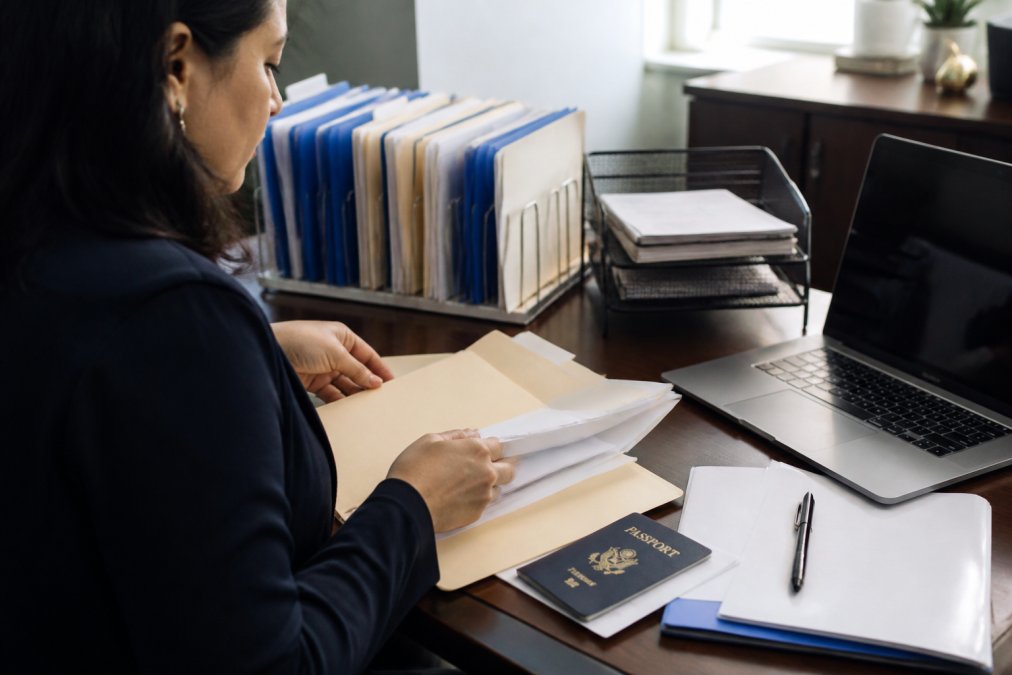
A digital system keeps documents organized, searchable, and backed up. Understanding how documents flow through the National Visa Center (NVC) portal ensures you organize them to match how government agencies review your case.
Understanding the NVC Portal and Document Submission
Creating a Submission-Ready Digital System
Preparing Documents for the Consular Interview
Tracking Documents Through the Process
Create a master tracking spreadsheet with these columns:
- Document Name: Exact name of the document
- Status: Obtained / Pending / Uploaded to NVC / Submitted to Interview / Approved
- Date Obtained: When you received or created the document
- Expiration Date (if applicable): Passport expiration, police certificate validity (typically 6-12 months from issue date)
- Where Stored: Cloud folder, physical binder, safe deposit box
- Notes: Any issues, translations needed, follow-up required
Cloud Backup and Access Control
Avoiding Common Organization Mistakes
- Mixing original and copy files: Label files clearly as “Original” or “Copy” so you know which to bring to the interview.
- Uploading documents in the wrong category: The NVC portal has specific categories. A marriage certificate goes in Civil Documents, not Financial Evidence. Uploading to the wrong category confuses the consular officer reviewing your file.
- Submitting documents that are too old: Bank statements older than 30 days, employment letters older than 60 days, or police certificates older than their validity period (typically 6-12 months) will trigger requests for updated documents.
- Forgetting translations: Every document not in English must have a certified English translation. Submitting a foreign-language document without a translation is an automatic request for evidence.
- Poor scan quality: Blurry or incomplete scans are rejected. Rescan any document that’s hard to read. Use a document scanner app (Adobe Scan, Microsoft Lens) rather than a phone camera for better quality.
Before uploading to the NVC portal, print each document and review it as if you were the consular officer. Is it legible? Is it complete? Does it have a certified translation if needed? This final check catches mistakes before submission.
The NVC portal has file upload deadlines. Missing a deadline can delay your interview appointment by months. Set phone reminders for upload deadlines and check your NVC account weekly for new requests or notifications.
Frequently Asked Questions
What documents do I need for an immigrant visa interview?
You’ll need your valid passport, civil documents (birth certificate, marriage certificate if applicable), medical examination results, police certificate, financial evidence including the affidavit of support form I-864, employment verification, and any documents related to your USCIS petition approval. The National Visa Center will provide a specific document list based on your visa category. Have both original documents and certified translations ready.
What civil documents are required for the immigrant visa process?
Civil documents for immigrant visa interview typically include your original birth certificate, marriage certificate (if married), divorce decrees (if previously married), and adoption papers (if applicable). All documents must be certified copies or originals. If issued in another language, provide certified translations alongside the originals. These establish your identity and family status for consular processing.
How do I complete the affidavit of support form I-864 requirements?
Form I-864 requires your sponsor to demonstrate sufficient income to support you at 125% of the federal poverty guidelines (or 100% if the sponsor is a relative and has an annual income above the requirement). Your sponsor must provide tax returns, W-2s, and employment verification. The affidavit of support form I-864 requirements also include listing household members and their income. Work with an immigration attorney to ensure accuracy.
What are the first steps to file for naturalization 2026?
To file for naturalization 2026, you must first hold a green card for at least five years (or three years if married to a U.S. citizen), pass an English and civics test, and demonstrate good moral character. File Form N-400 with USCIS. Gather documents proving your green card status, tax returns, and employment history. An immigration attorney can guide you through eligibility and help you avoid common errors that delay processing.
What documents trigger an RFE in immigrant visa applications?
Common RFE triggers include missing or expired civil documents, insufficient financial evidence on the affidavit of support form I-864, medical examination results that don’t match USCIS requirements, police certificates that lack official seals, or gaps in employment verification. Incomplete DS-160 forms and inconsistent biographical information across documents also generate requests for evidence. Submitting certified originals and having an attorney review your package before submission reduces RFE risk significantly.