


Table of Contents
- What Is an LLC and Why It Matters for Small Business Owners
- The Core Benefits of LLC Formation for Small Businesses
- LLC Tax Advantages for Small Business Owners
- LLC vs Sole Proprietorship: Pros and Cons Side by Side
- Cost of Starting an LLC by State: Arizona and New Mexico
- Disadvantages and Limitations Every Owner Should Know
- Benefits of LLC Formation: Is It the Right Move for Your Business?
- Conclusion
Last Updated: August 8, 2026
What Is an LLC and Why It Matters for Small Business Owners
A limited liability company (LLC) is a business structure that combines the personal liability protection of a corporation with the tax simplicity of a sole proprietorship or partnership. For small business owners, this combination is valuable and real. At Kanu & Associates, P.C., we work regularly with entrepreneurs in Arizona and New Mexico weighing this decision. The honest answer is that the benefits of LLC formation are significant, but they are not automatic. The structure only protects you if you set it up correctly and maintain it properly.
An LLC is recognized as a separate legal entity from its owners, called members. That single fact is the foundation of everything else in this guide.
The Core Benefits of LLC Formation for Small Businesses

Limited Liability Protection: Keeping Personal Assets Safe
Limited liability protection means that if your business is sued or cannot pay its debts, creditors generally cannot come after your personal assets: your home, savings account, or personal vehicle. Without an LLC, a sole proprietor’s personal and business finances are legally the same thing. One lawsuit or unpaid vendor debt can reach everything you own.
The liability shield created by an LLC is sometimes called the corporate veil. Courts will respect it as long as you treat the LLC as a genuinely separate entity, keeping separate bank accounts, not commingling personal and business funds, and maintaining basic statutory requirements. This protection matters most in industries with meaningful legal exposure: contractors, consultants, real estate investors, and anyone entering into significant contracts.
Credibility and Legal Identity with Clients and Partners
A registered LLC signals seriousness. Many larger clients, vendors, and lenders prefer to contract with a formal business entity rather than an individual. The legal identity an LLC provides also makes it easier to open a dedicated business bank account, apply for business credit, and sign contracts that clearly delineate business obligations from personal ones.
Management and Operational Flexibility
Unlike corporations, LLCs are not required to hold annual shareholder meetings, maintain a board of directors, or follow rigid governance procedures. An LLC can be member-managed, where all owners participate in decisions, or manager-managed, where designated managers handle operations while other members remain passive investors. The operating agreement lets members define their own rules for profit distribution, decision-making authority, and exit procedures.
LLC Tax Advantages for Small Business Owners
Pass-Through Taxation and the S-Corp Election
By default, an LLC is treated as a disregarded entity for federal tax purposes if it has one member, or as a partnership if it has multiple members. Business income passes through directly to members’ personal tax returns, avoiding the double taxation that C-corporations face.
A further option that many small business owners overlook is electing to be taxed as an S-corporation. Under this election, the LLC still avoids double taxation, but the structure of how income is categorized changes in a way that can reduce the total self-employment tax burden. According to IRS guidance on S-corporation elections, an LLC can file Form 2553 to make this election, subject to eligibility requirements. The S-corp election works best when the business generates enough net profit to justify paying the owner a reasonable salary while distributing the remainder as profit distributions.
Self-Employment Tax Impact: What Most Guides Skip
When an LLC is taxed as a sole proprietorship or partnership, all net business income is subject to self-employment tax, which covers Social Security and Medicare contributions. For businesses generating significant net profit, this becomes a material cost. The S-corp election addresses this by allowing the owner to draw a reasonable salary (subject to payroll taxes) and take remaining profits as distributions (not subject to self-employment tax).
A single-member LLC files a Schedule C with the personal return. A multi-member LLC files a partnership return (Form 1065). An LLC with an S-corp election files Form 1120-S. Each has different compliance obligations and deadlines.
Electing S-corp status without first consulting a tax professional is one of the most common and costly mistakes new LLC owners make. The election has strict eligibility rules and procedural deadlines. Missing them means the election is void and you face unexpected tax consequences.
LLC vs Sole Proprietorship: Pros and Cons Side by Side
| Factor | LLC | Sole Proprietorship |
|---|---|---|
| Personal liability protection | Yes, limited liability shield | No, full personal exposure |
| Tax treatment | Pass-through (default); S-corp election available | Pass-through, Schedule C |
| Self-employment tax | Applies to all income (unless S-corp election) | Applies to all net earnings |
| Formation requirement | State registration required | No formal registration needed |
| Administrative burden | Annual report, state fees, operating agreement | Minimal compliance requirements |
| Credibility with clients | Higher, recognized legal entity | Lower, seen as informal |
| Cost to start | State filing fee plus legal/registered agent costs | Effectively zero |
| Business continuity | Survives member changes (if structured correctly) | Ends with the owner |
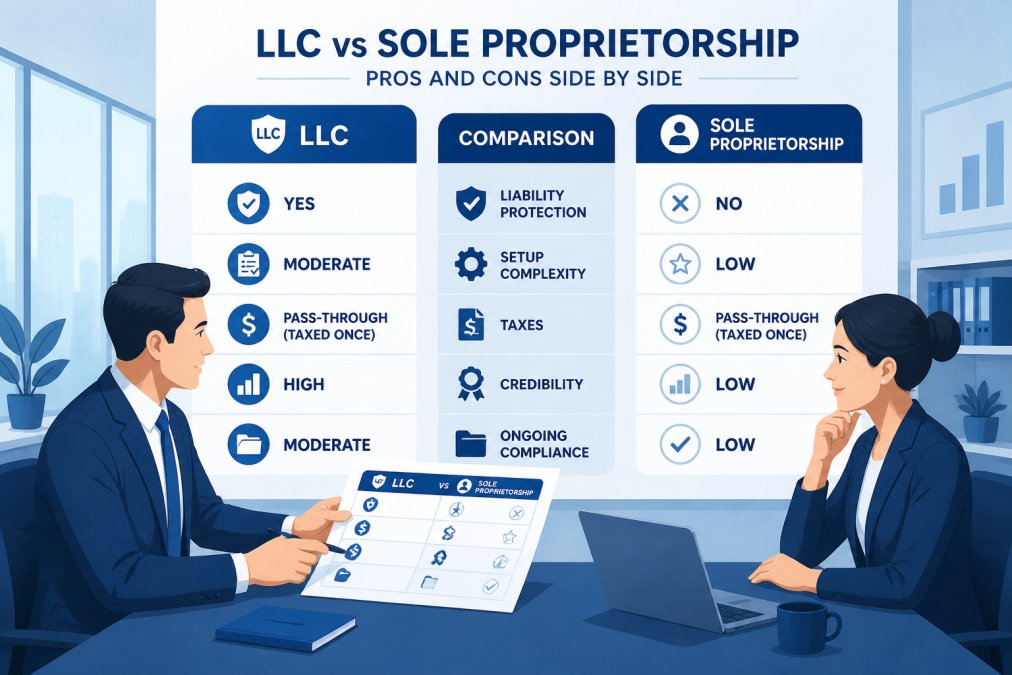
The sole proprietorship wins only on simplicity and upfront cost. For any business that carries meaningful legal exposure, signs contracts, or expects to grow, the LLC’s liability shield and credibility advantages outweigh the additional formation costs and administrative burden quickly.
A sole proprietorship costs nothing to start but puts everything you own at risk. An LLC costs more to form and maintain, but the liability shield it provides is worth far more than the filing fee the first time a dispute arises.
Cost of Starting an LLC by State: Arizona and New Mexico
Arizona LLC formation requires filing Articles of Organization with the Arizona Corporation Commission. Arizona also has a publication requirement: new LLCs must publish a notice of formation in an approved newspaper for three consecutive weeks. This requirement adds to the total formation cost and is a step that out-of-state guides often miss. Arizona does not impose a state income tax on LLCs at the entity level, but members still pay state income tax on their share of business income. Check the Arizona Corporation Commission business filing portal for current filing fees.
New Mexico LLC formation is handled through the New Mexico Secretary of State’s office. New Mexico does not require a published notice of formation, which keeps initial costs lower. New Mexico also does not impose an annual report requirement for LLCs, which reduces ongoing compliance obligations. However, New Mexico does impose a gross receipts tax on business income, which affects how LLCs price their services. Review current requirements through New Mexico Secretary of State business services.
Both states require a registered agent with a physical address in the state. Members who live in the state often serve as their own registered agent, but using a professional registered agent service adds privacy and ensures compliance notices are handled properly.
Arizona’s newspaper publication requirement catches many new business owners off guard. Budget for it at the outset and confirm which newspapers are approved by the Arizona Corporation Commission before publishing.
Disadvantages and Limitations Every Owner Should Know
Asset Protection Limitations and the Corporate Veil
The liability shield an LLC provides is not absolute. Courts will "pierce the corporate veil" and hold members personally liable when they find that the LLC was not genuinely operated as a separate entity. Common reasons include commingling personal and business funds, failing to maintain an operating agreement, using the LLC to commit fraud, or undercapitalizing the business.
In most states, a licensed professional cannot use an LLC to shield themselves from liability for their own malpractice. A professional LLC or PLLC may be required, and the protection it offers for professional acts is more limited.
Exit Strategy Implications for LLC Members
Unlike corporations, which have standardized share structures, LLC membership interests are governed by the operating agreement. If the operating agreement does not address what happens when a member wants to leave, dies, or becomes incapacitated, the resulting dispute can be costly and time-consuming.
For single-member LLCs, the exit question is simpler but still matters: what happens to the business on the owner’s death? Without proper estate planning, the LLC may need to go through probate, which delays business continuity and creates tax complications.
Multi-member LLCs face a more complex version of this problem. Buy-sell agreements, valuation methods, and transfer restrictions all need to be addressed in the operating agreement before they become urgent.
Benefits of LLC Formation: Is It the Right Move for Your Business?
The benefits of LLC formation are strongest for businesses that carry real legal exposure, plan to sign contracts, expect to grow beyond a one-person operation, or want to establish credibility with clients and financial institutions.
The decision framework is straightforward:
- If you have personal assets worth protecting, an LLC makes sense.
- If you are entering into contracts with clients or vendors, an LLC makes sense.
- If you expect to bring on partners or investors, an LLC makes sense.
- If you are a licensed professional, check your state’s rules on PLLCs before choosing a standard LLC.
- If you are still in the idea-testing phase with no revenue and no contracts, a sole proprietorship may be reasonable as an interim structure.
The LLC decision is not just a legal question. It is a tax question, an estate planning question, and a long-term business strategy question. The structure you choose now affects how you pay taxes, how you exit the business, and how your ownership interest is treated if something happens to you. According to SBA guidance on choosing a business structure, the choice of entity is one of the most consequential early decisions a business owner makes.
Do not choose a business structure based on the lowest upfront cost. The cheapest option at formation can become the most expensive option after a lawsuit, a tax audit, or a dispute between partners. Structure the business correctly from the start.
Starting a business involves real legal and financial decisions that compound over time. The benefits of LLC formation are significant, but only when the structure is set up correctly, maintained properly, and aligned with your broader tax and estate planning goals. Kanu & Associates, P.C. provides dedicated business law and formation support for entrepreneurs in Arizona and New Mexico, with the practical guidance to help you choose the right structure, avoid costly errors, and build your business with confidence. Contact us to discuss your situation and get clear answers before you file.
Frequently Asked Questions
What is the downside of having an LLC?
LLCs come with real trade-offs. Formation requires state filing fees, an operating agreement, and ongoing compliance obligations like annual reports and, in some states, franchise taxes. Self-employment taxes apply to active members' income, which can increase the overall tax burden compared to a corporation. The liability shield can also be pierced if you commingle personal and business funds or fail to maintain the LLC as a separate legal entity. Understanding these drawbacks before forming is essential.
Is an LLC worth it for a small business?
For most small business owners, the benefits of LLC status outweigh the costs. Personal asset protection, pass-through taxation, and flexibility in management structure are significant advantages over operating as a sole proprietor. Whether it makes sense depends on your revenue, the nature of your legal exposure, and your state's specific fees and requirements. A business attorney can help you weigh the administrative burden against the protection you gain before you file.
Do you pay less taxes if you have an LLC?
An LLC itself does not automatically lower your tax bill. By default, a single-member LLC is taxed as a disregarded entity and a multi-member LLC as a partnership, both pass business income through to members' personal returns. However, an LLC can elect S-corporation tax treatment, which may reduce self-employment tax on a portion of profits. The actual savings depend on your net income, how you pay yourself, and your overall tax situation. Consult a tax professional for specifics.
How does an LLC protect personal assets?
An LLC creates a separate legal entity distinct from its owners. If the business is sued or cannot pay its debts, creditors generally cannot pursue members' personal assets, such as a home, savings, or personal vehicle, to satisfy those obligations. This liability shield holds as long as members treat the LLC as a genuinely separate entity: maintaining a dedicated business bank account, keeping separate records, and not mixing personal and business finances. Ignoring these steps risks having courts disregard the protection entirely.
This article was written using GrandRanker