


Table of Contents
- Eligibility Requirements to File for Naturalization in 2026
- Form N-400 Checklist: Documents You Need Before You Apply
- USCIS N-400 Filing Fee 2026 and Fee Waiver Options
- How to File for Naturalization: Online vs. By Mail
- Naturalization Processing Times 2026 and How to Track Your Case
- How to Prepare for the Naturalization Interview
- From Oath Ceremony to Naturalization Certificate: Final Steps
- Conclusion
Last Updated: August 7, 2026
Eligibility Requirements to File for Naturalization in 2026
Naturalization is the legal process by which a lawful permanent resident becomes a United States citizen. At Kanu & Associates, P.C., we work with immigrants across Arizona and New Mexico ready to take this step. The most common mistake we see is applying too early or not knowing which residency track applies.
The core requirements, according to USCIS eligibility overview for naturalization, include being at least 18 years old, holding a valid green card, demonstrating continuous residence, meeting physical presence thresholds, showing good moral character, and passing the English and civics requirements. Missing one of these will result in denial.
The 5-Year vs. 3-Year Residency Rule
Most green card holders must wait five years as a lawful permanent resident before filing for naturalization. However, if you are married to and living with a U.S. citizen, that waiting period drops to three years, provided you have been a permanent resident for those three years and your spouse has been a U.S. citizen for the entire period.
The 90-day early filing rule makes this practical. USCIS allows you to submit Form N-400 up to 90 days before you reach your residency milestone. Calculate your eligibility date carefully before applying.
Continuous Residence, Physical Presence, and Good Moral Character
Continuous residence means you have not abandoned your permanent resident status. A single trip outside the U.S. lasting more than six months can disrupt this; a trip over one year generally breaks it entirely. Physical presence is separate: under the five-year track, you must have been physically present in the U.S. for at least 30 months of the five years. Under the three-year track, it is 18 months.
Good moral character covers the period of required residence. Criminal convictions, tax issues, failure to register for Selective Service, and certain civil matters can affect your eligibility. If you have any legal history, speak with an immigration attorney before filing.
Form N-400 Checklist: Documents You Need Before You Apply
Getting your documents in order before filing directly affects how quickly your case moves. Missing documents are a leading cause of delays and Requests for Evidence.
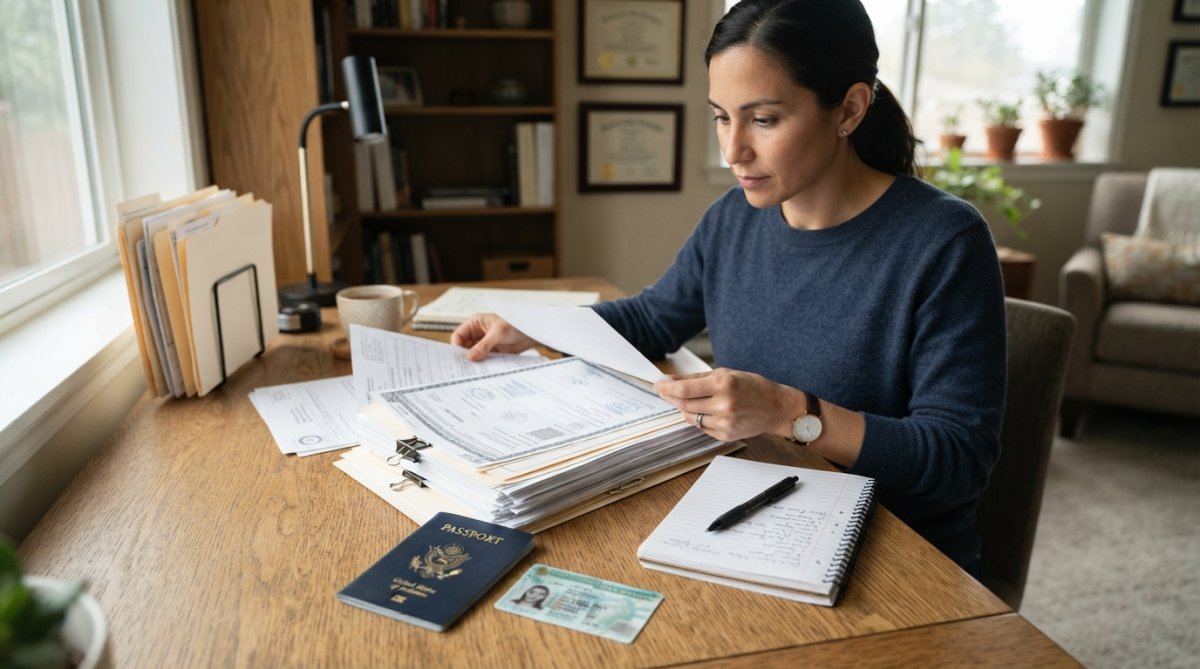
Here is a practical checklist for most applicants:
- Copy of both sides of your Permanent Resident Card (green card)
- Passport-style photographs (check current USCIS photo specifications before submitting)
- Copies of all passports or travel documents used since becoming a permanent resident
- Evidence of continuous residence (utility bills, lease agreements, tax returns, bank statements)
- Evidence of trips outside the U.S. (travel records showing dates and destinations)
- If applying under the 3-year rule: marriage certificate and evidence of current marital union
- If you have ever been arrested or cited: court records for every incident, even if charges were dropped
- Tax transcripts or copies of filed federal returns for the past five years
- Selective Service registration documentation (for male applicants who were required to register)
- Any prior immigration court records or removal proceedings documentation
The Form N-400 itself runs 20 pages with over 130 questions. Answer every question honestly. USCIS cross-references your answers against federal databases, and inconsistencies can generate a Request for Evidence or trigger additional scrutiny.
| Document Category | Why It’s Required | Common Mistake |
|---|---|---|
| Green card copy (both sides) | Confirms permanent resident status | Submitting front only |
| Travel records | Verifies continuous residence and physical presence | Missing short trips |
| Tax transcripts | Demonstrates good moral character | Omitting years with late filings |
| Court records | Required for any arrest, even dismissed cases | Assuming dismissed = irrelevant |
| Marriage certificate | Required for 3-year track applicants | Not including joint domicile evidence |
USCIS N-400 Filing Fee 2026 and Fee Waiver Options
The USCIS N-400 filing fee for 2026 should be confirmed directly on the USCIS fee schedule for Form N-400 before you submit, as fees are subject to change. As of the most recent USCIS schedule, there is a biometric services fee included for most applicants under 75 years old.
Fee waivers are available for applicants who cannot afford the filing fee. Submit Form I-912 (Request for Fee Waiver) along with your N-400. USCIS grants fee waivers based on documented financial hardship, receipt of a means-tested benefit, or income at or below 150% of the Federal Poverty Guidelines.
If you are currently receiving Medicaid, SNAP, or SSI, you may qualify for a fee waiver automatically. Gather your benefit award letters before filing and attach them to Form I-912.
Submitting a fee waiver request does not reduce your chances of approval. USCIS evaluates the waiver separately from the merits of your naturalization application.
How to File for Naturalization: Online vs. By Mail
Most applicants today have two options: file online through a USCIS online account or mail a paper application to the appropriate USCIS lockbox facility. The online route is faster, more trackable, and reduces the risk of administrative errors.
Filing Online Through Your USCIS Account
Filing online through your USCIS account is the more practical option for most applicants:
- Create a USCIS online account at the official USCIS website if you do not already have one.
- Start Form N-400 within your account and complete each section carefully.
- Upload supporting documents as prompted. Scan all documents clearly before you begin.
- Pay the filing fee online using a credit card, debit card, or bank account.
- Submit the application and save your confirmation receipt number (starts with IOE).
Your receipt notice will appear in your online account, and you can track your case status in real time from the same dashboard.
Mailing Your Application and What Happens Next
If you choose to file by mail, download the most current version of Form N-400 from the USCIS website. Mail your package to the correct USCIS lockbox address for your state, listed on the USCIS website.
After USCIS receives your mailed application, you will receive a paper receipt notice (Form I-797) by mail, typically within a few weeks. This notice includes your receipt number, which you can use to check your case status online.
Naturalization Processing Times 2026 and How to Track Your Case
Naturalization processing times in 2026 vary by USCIS field office and fluctuate based on application volume and staffing. The most accurate and current processing times are published on the USCIS processing times tool, updated monthly by office.
After filing, track your case using your receipt number through the USCIS online case status tool. If you filed online, your account dashboard provides real-time updates. If your case exceeds the published processing time for your field office, you can submit a case inquiry through your USCIS online account or contact the USCIS Contact Center.
Common RFE Triggers and How to Avoid Delays
A Request for Evidence is not a denial; it means USCIS needs more information. However, RFEs add months to processing time, and many are entirely avoidable.
The most common triggers include:
- Incomplete travel history: Missing even a short trip outside the U.S. raises questions about physical presence calculations.
- Undisclosed arrests or citations: USCIS cross-references criminal databases. If an arrest appears in their records and you did not disclose it, the application is flagged immediately.
- Tax filing gaps: Missing tax years or unfiled returns require explanation and documentation.
- Selective Service non-registration: Male applicants between certain ages who did not register must provide an explanation.
- Inconsistencies between the N-400 and prior immigration filings: Dates, names, and addresses must match across all immigration records.
Never leave any question on Form N-400 blank. If a question does not apply to you, write “N/A.” A blank answer can trigger a Request for Evidence or rejection.
How to Prepare for the Naturalization Interview
The naturalization interview is the part of the process most applicants find most stressful. For applicants with clean records, straightforward travel histories, and well-prepared applications, the interview is often shorter and less adversarial than expected. Preparation makes the difference.

USCIS will schedule your interview at the local field office after your biometrics are processed. You will receive a written notice with the date, time, and location. Bring your original documents, including your green card, passport, and any supporting documents relevant to your application.
At Kanu & Associates, P.C., we help clients prepare for this interview by reviewing the application line by line for inconsistencies, and advising on how to present complex situations clearly and honestly.
The Civics Test and English Proficiency Requirements
The civics test requires applicants to answer questions drawn from a list of 100 civics questions covering U.S. history and government. The officer asks up to 10 questions, and you must answer at least 6 correctly to pass. The full list of 100 questions and answers is publicly available and should be studied in advance.
The English proficiency requirement means you must demonstrate the ability to read, write, and speak basic English. The officer will evaluate this during the interview itself. Certain applicants may qualify for exemptions based on age and years of permanent residence.
The civics test is not designed to trick you. Every question and its accepted answer is published by USCIS in advance. Study the full 100-question list and practice speaking the answers aloud.
Biometrics Appointment and What to Bring
Before your interview, USCIS will schedule a biometrics appointment at an Application Support Center. You will receive a written notice with your appointment date and location.
Bring your biometrics appointment notice and a valid government-issued photo ID. Missing it without rescheduling will delay your case.
From Oath Ceremony to Naturalization Certificate: Final Steps
Once your interview is approved, the final step is the Oath of Allegiance ceremony. Some applicants receive same-day oath ceremonies immediately following a successful interview. Others are scheduled for a separate ceremony at a later date.
At the oath ceremony, you will surrender your Permanent Resident Card and take the Oath of Allegiance to the United States. After the oath, USCIS issues your Certificate of Naturalization, which serves as your primary proof of U.S. citizenship.
With your naturalization certificate in hand, you can apply for a U.S. passport, register to vote, and access immigration benefits for eligible family members. As documented in Department of State passport application guidance, a U.S. passport serves as independent proof of citizenship and is the most practical document to carry day to day.
Keep your naturalization certificate in a secure location. If it is lost or damaged, you will need to apply for a replacement using Form N-565, which involves additional fees and processing time.
The naturalization process involves precise eligibility calculations, extensive documentation, and a formal USCIS interview, all of which carry real consequences if handled incorrectly. Kanu & Associates, P.C. provides knowledgeable, practical immigration legal support to clients in Arizona and New Mexico, helping them avoid the errors that cause delays and denials. Contact us to discuss your naturalization case and move forward with confidence.
Frequently Asked Questions
What are the eligibility requirements for naturalization in 2026?
To file for naturalization in 2026, you must be a lawful permanent resident (green card holder) who has held that status for at least five years, or three years if married to a U.S. citizen. You must also meet continuous residence and physical presence requirements, demonstrate good moral character, pass the civics test and an English proficiency evaluation, and be willing to take the Oath of Allegiance. USCIS reviews your full immigration status history during adjudication.
How long does it take for USCIS to process an N-400 application in 2026?
Naturalization processing times in 2026 vary by USCIS field office and individual case complexity. Processing can range from several months to over a year. After filing, USCIS will schedule a biometrics appointment, then a naturalization interview. You can monitor your application status online through your USCIS account using the receipt number on your Form I-797 notice. Cases involving criminal history or prior immigration issues typically take longer to adjudicate.
Can I get a fee waiver for the N-400 filing fee?
Yes. If you cannot afford the USCIS N-400 filing fee, you may request a financial hardship fee waiver by submitting Form I-912 with your application. USCIS evaluates waiver requests based on income, household size, and financial circumstances such as receipt of means-tested public benefits. Not all applicants qualify, and a denied waiver will delay your application. Check the USCIS website for current income guidelines before submitting Form I-912.
How do I check my N-400 application status online?
After USCIS accepts your Form N-400, you receive a Form I-797 receipt notice with a unique case number. Log in to your USCIS online account at uscis.gov to track your application status in real time. You can also sign up for email or text notifications when your case moves to a new stage. If your case appears stuck or you receive a Request for Evidence, consulting an immigration attorney promptly can help you respond correctly and avoid further delays.
This article was written using GrandRanker